The second post in Emergent Stories comes from Marcus Barrick, who writes at Return to Process on Substack. It is a fable and an anatomy at once: if information is our food, what does it mean to digest it well? Drawing on the Emergent gathering, Marcus follows the whole metabolic cycle; foraging, tasting, absorbing, fasting, and letting go.
Let’s begin with a story
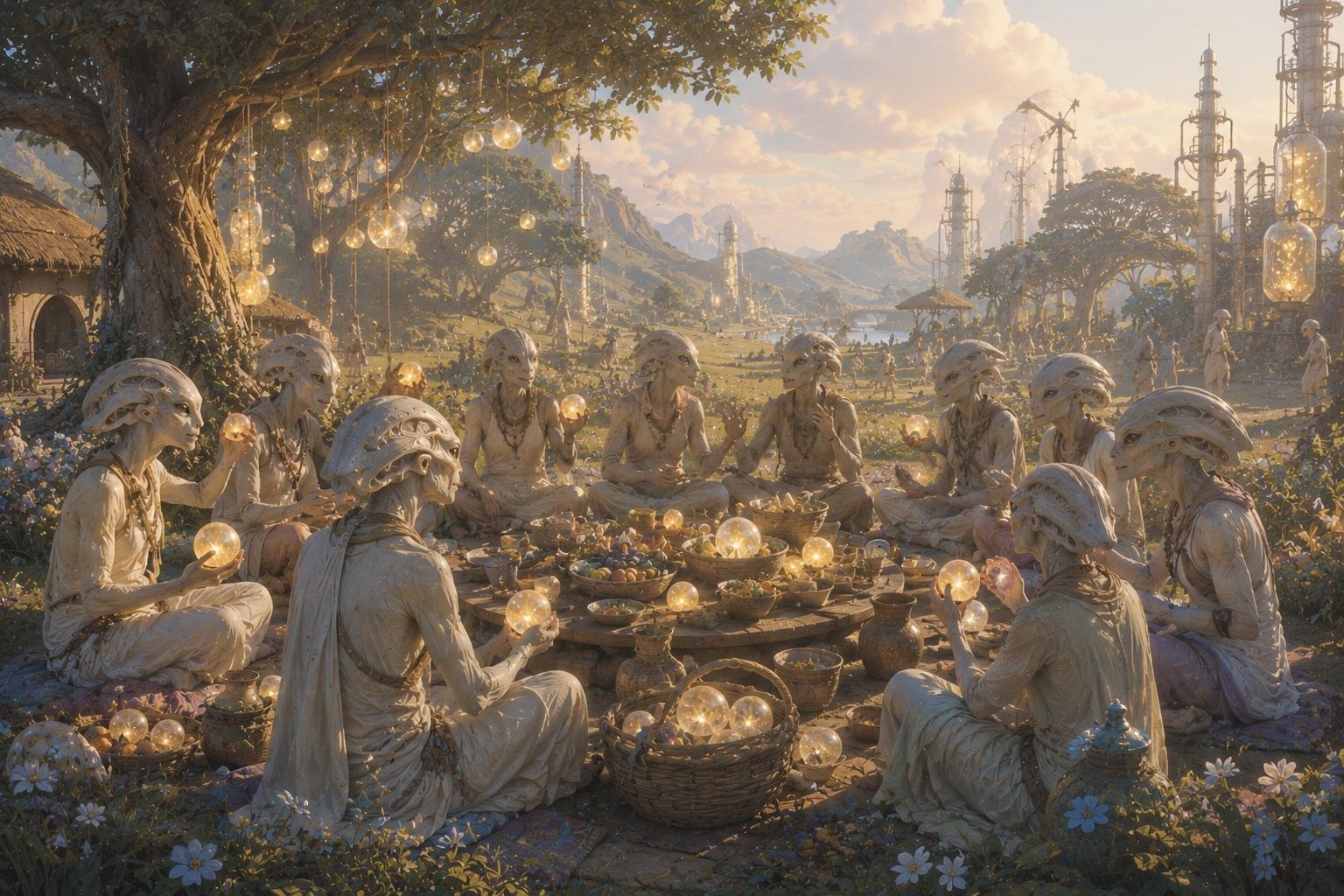
Just as on any other day, infovores roamed the salience landscape. But today, they sought to notice the moment when information first entered their minds. They smelled the breeze infused with eastern sandalwood and newly flowering fields of study from the West. A deep remembering stirred: that smell is the first moment of digestion—though this was long masked by the decaying piles of old paradigms and the rhetorical rot and epistemic pollution lingering in the Ol’Factories of knowledge. But they all recall the times of hunting and gathering insights in the wild, tilling the fields of discourse, or refining epistemic farming into a science, that moment they had to climb a tree to taste a new fruit as all the low hanging ones had been plucked.

Although each infovore had their own dietary restrictions and energetic needs, their meals were always accompanied by collective conversation; without such communion, next year’s harvest would not pollinate, and their culture would not ferment. Their palettes welcomed the mild, the medium, and the spicy, as taste, for them, was a sense of epistemic valence. Each byte, more flavorful on a fasted stomach, perplexed as the newly discovered fruits made first contact with their guts. In the evenings, they metabolized information through somatic absorption, breath, and dance, becoming the tidal waves that churned their intestinal tracts. But only silence could clear the congestion, allowing them to break their fast once again, to smell the morning breeze anew.
For an infovore, nutrition and satiation are not found in consuming raw information. Information must be processed, integrated, and its waste shed—individually and collectively. If information is their food, they need a digestive system to parse what to integrate and what to release. To take in too much too fast is to bloat; to cling to undigested fragments is to constipate the psyche; to process too little is to starve one’s agency. Infovores aren’t passive receptacles. They are interwoven with the informational landscape.
Foraging in the Forest of Knowledge
Fruits only come into focus when the senses converge and the collective co-constructs a sturdy but not rigid cognitive scaffolding to traverse the landscape. Only then can there be spaciousness in the social terrain, welcoming long treks to the edge of reason, where the path of inquiry becomes more noticeable than the destination. Collective insight occurs when multiple layers of subtle and gross signals resonate across individuals, allowing conversation itself to grow new lenses and footholds to reach fruits once grafted onto the highest branches. Whether that new graft was a sturdy placement was made possible only through discernment, nonverbal cues, and the path dependent intentionality that was interwoven. These were all subtle cues that have not yet budded into information yet, moreover the proliferation of leaflets of information often congested the path, making it harder to see the fruits along the way and the way itself.
It is there that deep learning is integrated, shaping the way reality is disclosed. It is through experience that smell becomes an anticipatory inference, and taste develops into affective Bayesian priors that shape the infovore’s path. Co-evolving symbiotic relationships develop between their gut cultures and their social culture, and between their inner salience landscape and their outer landscape. Be it from developing new internal organs (attention-shaping modalities, contemplative practices, and social norms) or external organs (scopes of various kinds, writing tablets, and seemingly magical surfaces of reflection).
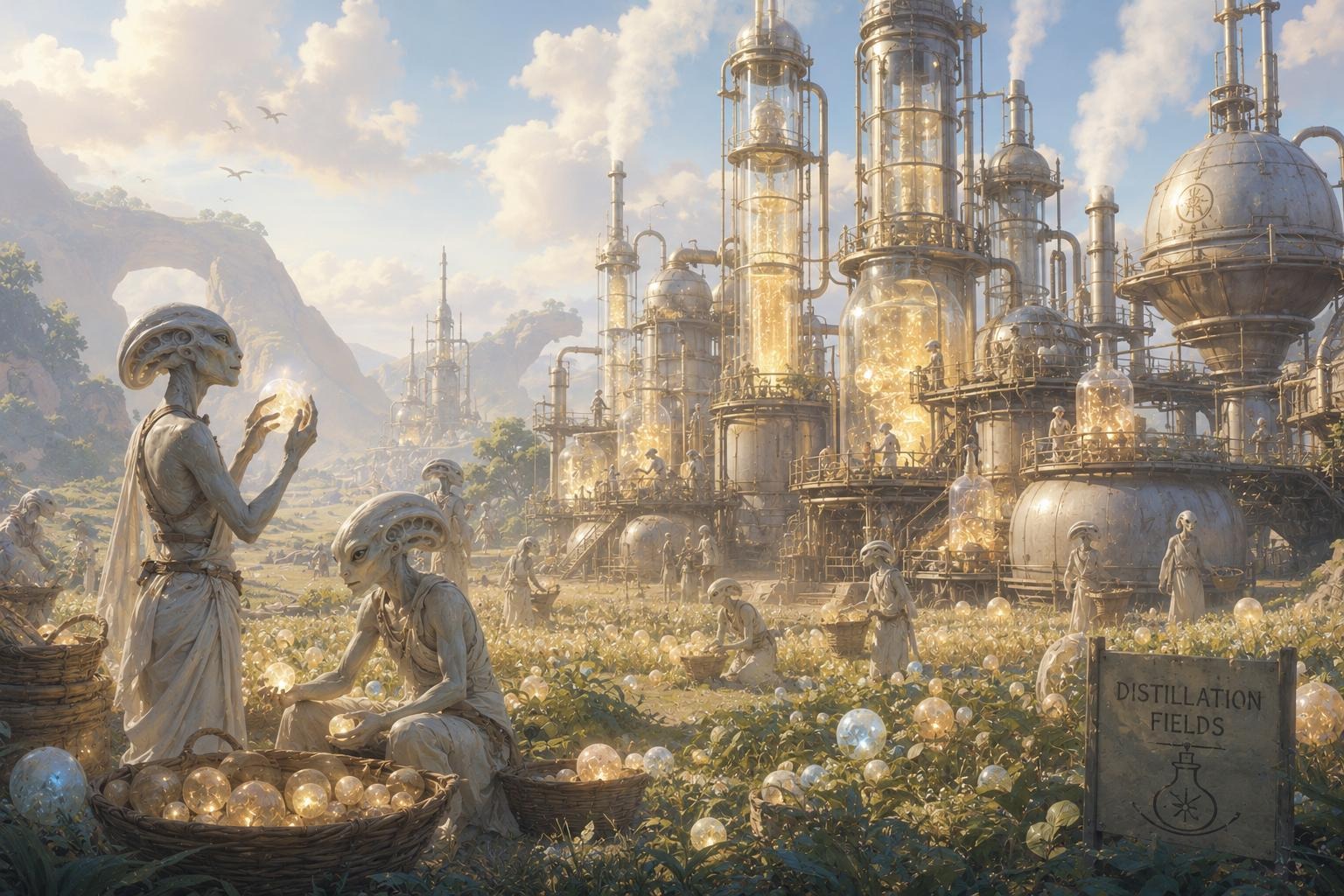
All the while, across the valley, the Science-Farmers had innovated rapidly. After inventing cold storage, the accumulation of information became cheap, and soon everything was packed into the same box. They built crawlers to cheaply search the terrain, and everything in the box was considered fruit. But it was the invention of the distillation tower that made information abundant—too abundant—and everything became sugar.
Energy was on tap. Excitability rose. And they soon noticed: when information inflates, wisdom withers. Everything grew flavorless. The figs turned to powder. Excitability didn’t lead to integration. Discernment became impossible; the profound sat beside the profane, insight next to the mundane. Context evaporated from the now dehydrated fruit. The very concept of a fig became an image; knowledge thinned into content. And if content wasn’t eaten, it rotted and corrupted the landscape. They invented the fermentation vat to reintroduce culture, but it came with its own challenges. It digested information for them, cultivating bacterial communities to re-enrich the substrate. But the cultures often collapsed into monoculture, and consumed all their sugar.
Perplexity: The Stomach Acid of Cognition

We are infovores who learn to notice how to orient when tasting something for the first time, a gut feeling: whether left in confusion or in perplexity?
At Emergent, confusion was described as: “I don’t know what’s going on, I don’t have an answer, I’m turning away.” Perplexity, however, brings equanimity to not-knowing—an openness that asks, “What’s going on here?” Perplexity induces a new kind of knowing, much like the body transmuting the unpleasant into nourishment. Perplexity is the infovore’s acid bath that breaks down the raw, overwhelming mass of information, allowing subtler nutrients to permeate and create fertile ground for insight. An infovore must learn to remain in perplexity long enough for meaning to be felt, distilled, and absorbed—rather than regurgitating high-entropy information in search of fast clarity. Infovores are not satiated by content. They hunger for the low-entropy coherence of consilience—knowledge in context, knowledge as process. Accumulation dilutes the stomach acid of perplexity, leaving only the nausea of confusion.
Somatic and Social Absorption: Knowledge Must Be Metabolized
Many sessions at Emergent emphasized that information must be metabolized somatically, not just conceptually. One participant described how touching objects could be reframed as “being touched by the world”—allowing information to move through the body rather than merely into it. Facilitators reminded everyone: “Give your body and mind space to integrate this information… let it land.” That is digestion, not accumulation.
In the somatic group, one participant described releasing anticipatory cognition and experiencing a “deep somatic and emotional release,” fostering new trust in their intellectual capacities. Another spoke of accessing hidden trauma threads that emerged only through embodiment. The weekend revealed what many forget: understanding is not a head-bound affair. When the body digests experience, the mind becomes available. This occurs when the infovore ceases to hold information at a distance, akin to nutrients crossing the intestinal wall and becoming part of the organism—knowledge becoming lived capacity. Instead of storing insights as static content (mental fat), integrated information becomes responsive, connective, adaptive (cognitive muscle). Facilitators described how aligned individuals and systems operate across scales, updating rapidly and absorbing subtle vibrations without being dominated by them.
Knowledge is also metabolized socially. The complexity of engaging in collective dialogue across science, spirituality, and philosophy demands an adaptive, multiperspectival, pluralistic approach. Collective discussion functions like fermentation: a microbial ecosystem of perspectives breaking down the tough fibers of experience that no individual can digest alone. A healthy infovore relies on a plural gut biome—multiple epistemologies, somatic registers, developmental stages interacting to break down complexity. In this view, knowledge, truth, and reality are not passively discovered but actively co-constructed through language, interaction, and shared practice; they are negotiated and enacted. Many discussions noted the need for wise orientation to knowledge, as individuals, organizations, or AI aspiring to be the oracle of truth results in conflict, not clarity. These are perennial problems, and such negotiation and digestion takes time. Neglecting this means wisdom arrives even later. Slowing down for somatic and social digestion enhances integration and insight, whereas immediate glucose spikes for energy cause excitability and cleverness, leading to disease and chaotic thoughts.
Fasting: Clearing Residue from Overconsumption
There was talk of information, or more specifically, meaning, as having mass and momentum, a kind of information realism. For our purposes here, treating information as immaterial appears to congest the psyche. Amidst media saturation and information overload, an information diet becomes a source of clarity, not deprivation. It is not only that a calorie is not a calorie, but that nutritional value is not energy alone, but negative entropy, as Erwin Schrödinger famously described: “Life feeds on negative entropy.”
Several participants remarked on the overwhelming density of the weekend’s intellectual and spiritual content. Facilitators encouraged long walks, solitude, and silence—not as breaks from learning, but essential phases of assimilation. “Take a solo walk… give your body and mind space to integrate.” This is the fasting phase of the infovore’s cycle: clearing leftover fragments that, if unprocessed, ferment into confusion, ideology, dogma. Information-fasting is what enables: the emptying of old patterns, the composting of incomplete insights, purification of attention, and the timely return of intellectual appetite. Without fasting, sensemaking becomes gluttonous.
Releasing Our Grasp: The End of Metabolism
Another theme at Emergent was the danger of clinging to experiences or insights that feel profound but distort long-term development. As one participant put it: mystical experiences are “interesting way stations,” but not the final reality; one must not get lost in them. This is elimination: releasing what the system cannot use. Letting go keeps the bodymind responsive rather than clogged by undigested insight-seeking.
As Michael Gershon notes in The Second Brain, the gut hosts 100 million neurons, operates semi-independently, produces most of the body’s serotonin, and deeply shapes mood, decision-making, and cognition. It evolutionarily predates the brain, has a neural architecture comparable to the brain, and is deeply involved with cognitive diseases like depression, anxiety, and Parkinson’s. Consciousness is undeniably metabolic. This invites us to consider not just breath and circadian rhythm but also the unprecedented capacities of energy available to us, both biochemical and electrical, and the forms of cognition it affords. Recognizing knowledge as metabolic—somatic, social, and lived—invites infovores to dampen resource-intensive strategies of acquisition. Accumulating knowledge is not the path toward wisdom, capability, or attunement.
Knowledge is impermanent; we cannot grasp it. Clinging constipates. The boundaries of metabolism are not merely fasted and full, but birth and death themselves. This reminds us why we hunger for knowing at all, and how suffering and care shape what we are concerned about, where we place our attention, and what kinds of knowledge are lacking in our social metabolism. The metabolic energy behind the birth of new ideas or new beings is immense, and grows only in soils of compassion—not mere intelligence.
The infovore’s digestive system is not just a metaphor but a blueprint for a healthier epistemic culture—one where knowledge is not hoarded but lived, shared, transformed. Knowledge survives only as metabolism: embodied, contextual, relational. When we decontextualize, proliferate, or outsource cognition into attention-driven information systems, we erode the ecological conditions that make relevance and wisdom possible. A metabolic view reminds us: knowledge lives only in the present, through integrating the warm data of relationships, not in cold storage.
You can find more of Marcus’s writing at his Substack, Return to Process.